A Growth Ecosystem
Supporting Non-linear Growth
Based on our Mission Grade System, we operate a "Growth Ecosystem" designed to foster the continuous growth of every employee.
We conduct "TGT" (Talent Development Committee), involving leadership ranging from Group Managers to Executive Officers, to review all Timee employees.
At TGT sessions, we identify individual strengths and characteristics, establish development policies, and deliberate on the specific missions to be offered to each employee.
By appropriately evaluating these challenges and results, and connecting them to even more challenging missions, we achieve both the non-linear growth of the company and the personal growth of the individual.
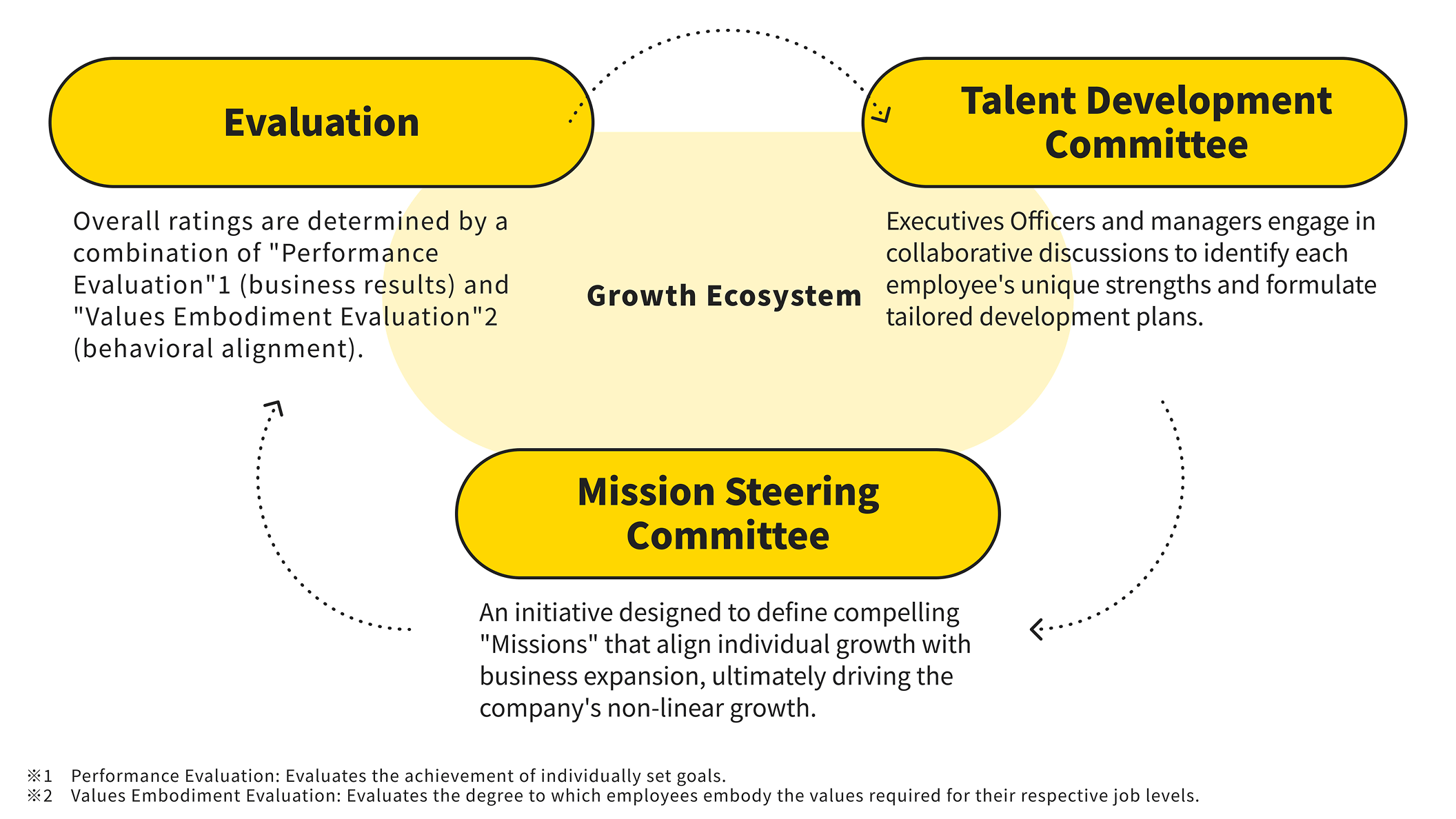
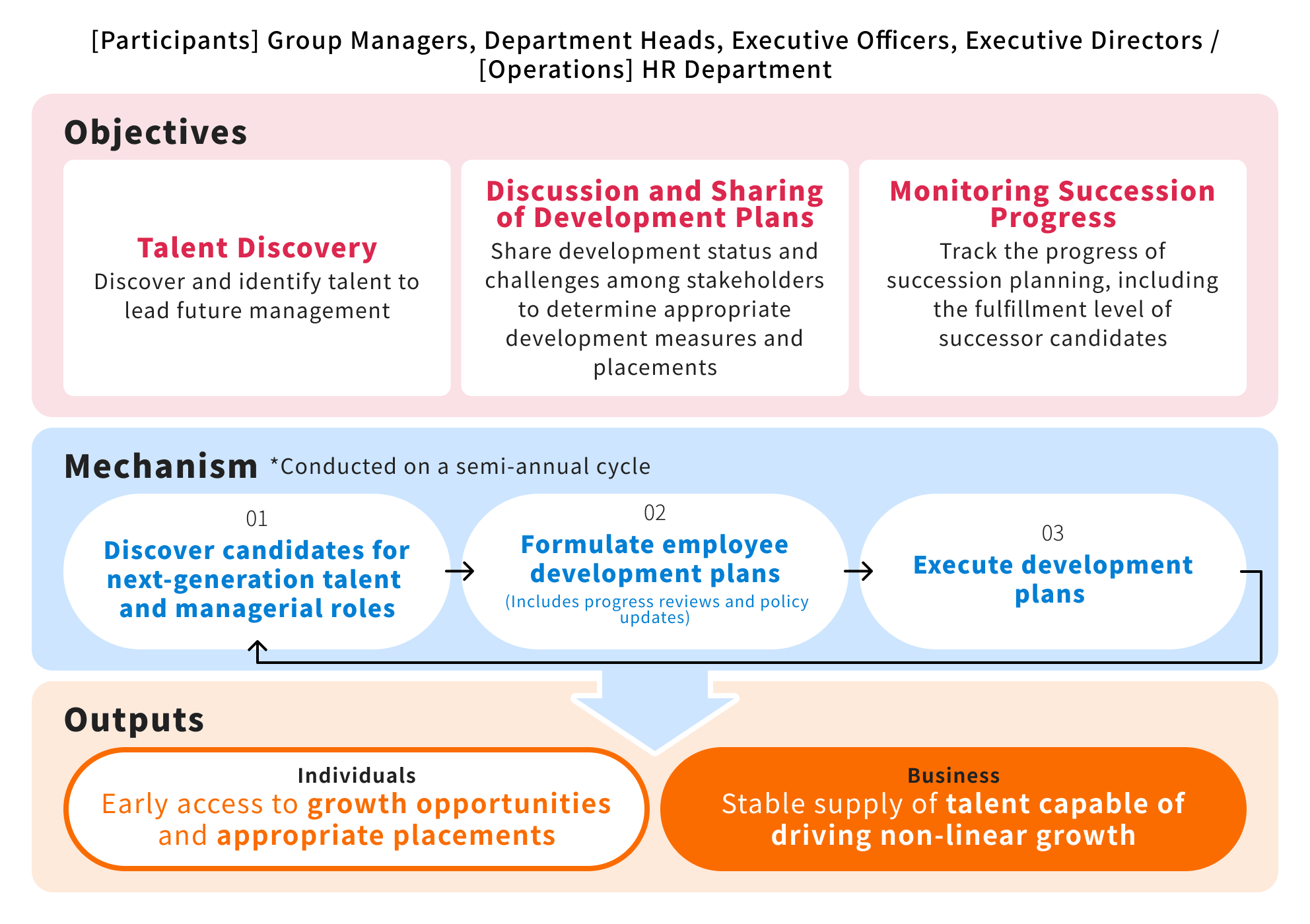
The Talent Development Committee (TGT: Timee's Got Talent) is an initiative designed to systematically develop next-generation talent capable of driving the non-linear growth of our business. Conducted on a semi-annual basis, the committee discusses employee development policies based on the current status of each organization and their daily achievements. The meetings are attended by Group Managers, Department Heads, Executive Officers, and Executive Directors. By designing and assigning challenging missions tailored to each employee, we foster growth that maximizes their individual strengths.
Objectives
The primary objectives consist of the following three points:
1. Discover and identify talent to lead future management
We identify talent with the potential for either "trailblazing” or "strategic planning" capabilities who can drive the non-linear growth of our business. We make comprehensive judgments based on evaluations and on-site performance to identify them as candidates for development at an early stage.
2. Share development status and challenges, and determine appropriate development measures and assignments
The strengths, challenges, and career aspirations of each targeted individual are shared among Group Managers, Department Heads, and Executive Officers. We discuss and determine development plans that combine Off-the-Job Training (Off-JT) with challenging stretch assignments, as well as their subsequent placements.
3. Monitor the progress of succession planning
We continuously track the fulfillment levels and development progress of successor candidates for key positions. Our goal is to establish an environment where talent capable of leading future management continues to grow without interruption.
Mechanism
The Talent Development Committee operates on a semi-annual cycle, focusing its discussions on the following three points:
1. Discover candidates for next-generation talent and managerial roles
From within our talent pool, we identify individuals with an aptitude for trailblazing or strategic planning roles, as well as potential candidates for managerial positions.
2. Formulate employee development plans
We create development plans based on individual evaluations, current conditions, and career aspirations. (This includes reviewing the progress of development measures decided at the previous meeting and updating development policies, assignments, and specific measures as necessary.)
3. Execute development plans
Based on the formulated plans, we execute mission assignments and provide continuous feedback.
Next-Generation Talent
At Timee, "next-generation talent" refers to individuals who possess a high capacity to confront and navigate uncertainty. We categorize this talent into two profiles: Trailblazing Talent and Strategic Planning Talent.
TrailblazingTalent
Individuals who build certainty through the accumulation of hands-on experience. They proactively and iteratively take action to mitigate uncertainty and forge breakthroughs.
Strategic Planning Talent
Individuals who mitigate uncertainty through hypothesis-driven thinking. With unwavering persistence, they uncover breakthroughs by consistently asking, "How can we increase certainty?"
The Mission Certification Committee is a framework designed to accelerate growth by providing opportunities for individuals to "voluntarily step up, make independent decisions, and take on challenges." Distinct from regular duties, missions are reviewed and certified by a committee comprising the management team, actively backing endeavors that generate a significant business impact.
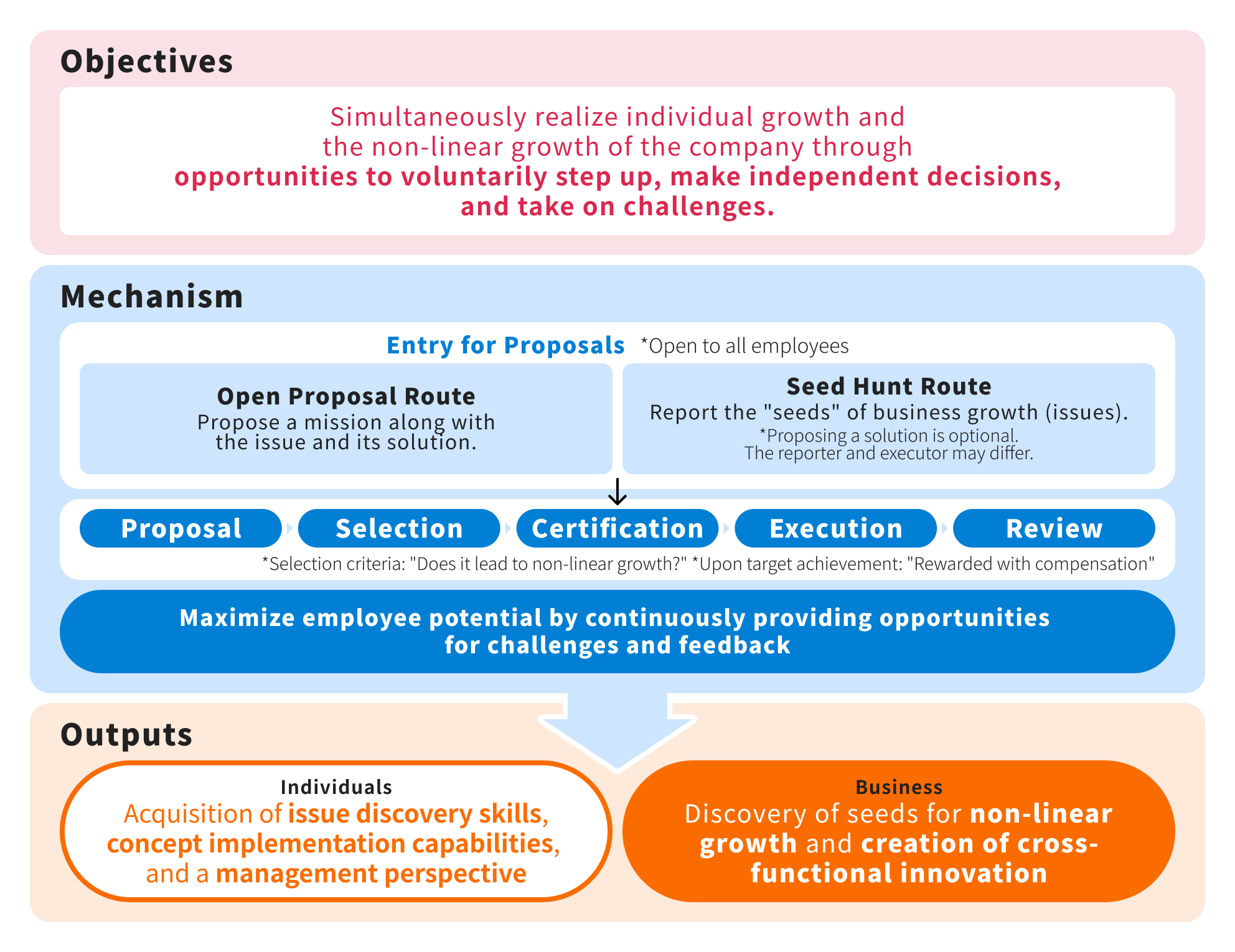
We offer two routes for submission: one is the Open Proposal Route, where individuals propose an issue along with a strategic scheme to solve it, and directly take on the challenge themselves. The other is the Seed Hunt Route, which begins simply by reporting an issue identified in the field. By sharing these early signs of business opportunities (the "seeds" of an issue) that have not yet taken the shape of a mission with the committee, we nurture them together. While the Open Proposal Route assumes the proposer will lead the execution, the Seed Hunt Route does not require the reporter and the executor to be the same person. This design intentionally lowers the barrier to entry, empowering anyone to take that crucial first step.
Objectives
We aim to maximize employee potential by providing abundant opportunities for challenges and continuous feedback. We translate issues and improvement ideas identified on the front lines into actual operational mechanisms, linking them directly to business results. This approach enables the simultaneous realization of individual growth and the non-linear growth of the company. The outcomes of these challenges are evaluated by the Certification Committee, creating a virtuous cycle that leads to subsequent growth opportunities.
Mechanism
Missions operate on a continuous cycle of "Proposal → Selection & Certification → Execution → Evaluation," consistently providing opportunities for challenges and feedback.
Proposers pitch directly to the executive team. The proposals are evaluated on their potential to drive "non-linear growth," with a strict focus on the perspective of the identified issue and the feasibility of the proposed solution.
Once certified, project leaders can assemble members across departments to drive the mission forward. Combining diverse skills cross-functionally has already generated numerous successful use cases. Upon execution, rewards are granted based on the degree of achievement against the promised target levels, ensuring a system that properly evaluates the outcomes of the challenge.
*In the Seed Hunt Route, the person who proposes the issue and the person who executes the mission may differ.