Investors

JA / EN

Corporate governance

Corporate Governance Guidelines

Timee, Inc. has established these Corporate Governance Guidelines for the purpose of clearly demonstrating our basic stance and initiatives regarding corporate governance to all of our stakeholders.

Timee, Inc.

Chapter I General Provisions

Article 1 (Basic policy related to corporate governance)

Under our vision of “Helping individuals create more valuable time,” we uphold the mission of “Building infrastructure for expanding life’s possibilities through work.” We recognize that earning a high level of trust from society is essential for our business continuity, which in turn leads to the maximization of corporate value. Our Directors, Audit & Supervisory Board Members, and employees understand their respective required roles, strive to continuously maintain and improve their awareness of laws, regulations, and social norms, and work to enhance corporate governance while engaging in proper and efficient management activities. We adopt the structure of a company with an Audit & Supervisory Board, which has a double-check function consisting of supervision of business execution by the Board of Directors and legality audits by the Audit & Supervisory Board, and we strive to ensure effectiveness by exercising checks on management from an objective and neutral standpoint.

Chapter II Appropriate Collaboration with Stakeholders

Article 2 (Securing Shareholders’ Rights)

We must strive to take appropriate action to ensure that all our shareholders, including minority and foreign shareholders, are treated substantially equally according to the number of shares they hold and can exercise their shareholders’ rights, including voting rights, at general meetings of shareholders.

Article 3 (General Meeting of Shareholders)
  1. We recognize that the general meeting of shareholders is our highest decision-making body, and we must facilitate the smooth operation of these meetings to ensure that our shareholders can exercise their voting rights appropriately.
  2. General meetings of shareholders and other related events must be scheduled on dates that avoid the typical peak days to ensure that more shareholders can attend, placing importance on dialogue with our shareholders.
  3. Notice of a general meeting of shareholders must be sent to each shareholder, with the accuracy of the information in the notice ensured, as a general rule, at least three weeks before the date for the meeting to ensure that shareholders have sufficient time to review the proposals for the meeting. Before notice of a general meeting of shareholders is sent to each shareholder, its Japanese and English text must be made available electronically on the website of the Tokyo Stock Exchange and on our website. Furthermore, we must secure convenience for our shareholders by participating in an electronic voting platform and taking other actions.
  4. For proposals receiving a considerable number of negative votes at a general meeting of shareholders, we must analyze the causes and discuss through the Board of Directors whether any further action is necessary.
  5. In preparation for cases where institutional or other investors who hold our shares through a trust bank or similar institution wish to exercise their voting rights or other shareholders’ rights at a general meeting of shareholders, we must discuss with these institutions in advance how to confirm that such investors are our beneficial shareholders, how beneficial shareholders can attend or observe general meetings of shareholders, and other related matters.
Article 4 (Fundamental Capital Policy)

We will implement a capital policy that takes into account the balance between making business and capital investments that contribute to our business growth, returning profits to our shareholders, and building internal reserves for future investments. To implement a capital policy involving a change of control or substantial dilution of our stock, we must fully discuss through the Board of Directors whether the capital policy is necessary and justifiable, fully explain the capital policy to our shareholders and other stakeholders under the Companies Act, the Financial Instruments and Exchange Act, the Tokyo Stock Exchange’s regulations, and other applicable laws and regulations, and lawfully and appropriately proceed with the procedures.

Article 5 (Cross-Shareholdings)

As a general rule, we will not hold shares of other firms through cross-shareholding. However, we will hold shares only if it is determined that an alliance with the investee through shareholding contributes to the business merits of our Group and the enhancement of our corporate value. For cross-shareholdings, the Board of Directors must regularly verify on an individual stock basis whether the continued holding of such shares contributes to increasing our corporate value, based on business execution merits and other economic rationality, taking into account the status of transactions with the relevant investee.

Article 6 (Anti-Takeover Measures)
  1. At the time of the establishment and latest revision of these Guidelines, no anti-takeover measures are in place.
  2. In the event of a large-scale takeover or a tender offer for our stock, the Board of Directors must strive to gather the necessary information and secure the necessary time to ensure that our shareholders can properly determine whether the takeover or tender offer should be accepted.
  3. Furthermore, in the cases mentioned in the preceding paragraph, the Board of Directors must request that the bidder clarify its management policies and other plans, and take appropriate actions to protect and increase our corporate value and the common interests of our shareholders, such as appropriately disclosing the Board’s position, whether it approves or disapproves, and the reasons for the position.
Article 7 (Related Party Transactions)

For related party transactions, we must sufficiently deliberate through the Board of Directors whether the transaction is necessary and justifiable under laws and regulations, and take appropriate action to ensure that the transaction does not harm the interests of minority shareholders.

Article 8 (Collaboration with Stakeholders Other Than Shareholders)

As a new infrastructure for “work,” we aim to create a society where each individual can expand their own possibilities. For workers, we stimulate the potential labor force and provide opportunities to expand life’s possibilities by creating opportunities to “work at their preferred times.” For employers (clients), we contribute to solving issues such as labor shortages and labor cost efficiency. By enhancing the engagement of both parties, we contribute to the sustainable growth of society.

To embody these values, we have established and must implement the following Code of Conduct, which all our employees must follow. The Board of Directors is responsible for establishing and revising this Code of Conduct as its own responsibility, and must regularly check and supervise whether it has permeated throughout the Company and is being practiced.

(Code of Conduct)

  • OWNERSHIP
    • Take ownership of the issues essential to achieve our Vision/Mission, think and act with initiative, and deliver results!
  • IDEALS FIRST
    • We aren’t held back by precedent. Working backward from an ideal state, we aim for new heights.
  • BE BRAVE
    • Take the first step, act fast, and push it through to the end with grit!
  • BOOSTER
    • Capture the signs of breakthrough growth, and spark a movement that boosts our team’s passion!
Article 9 (Whistle-blowing)

We must establish an internal whistleblowing contact point, with the Full-time Audit & Supervisory Board Member and the Legal Department designated as the contacts, and build a system to ensure appropriate information provision regarding internal violations of laws and regulations. We must make the existence and operational methods of the internal whistleblowing contact point known internally through our whistleblowing rules, and must not treat consulters or whistleblowers disadvantageously.

Article 10 (Full Information Disclosure)
  1. To contribute to the investment decisions of our shareholders and investors, in addition to appropriately disclosing the information required by laws and regulations, we must appropriately disclose our financial information, including our financial position and business performance, business strategies, risk management, and other information to ensure the transparency of such information.
  2. We must establish and disclose a disclosure policy that serves as a basic policy on appropriate information disclosure and transparency.

Chapter III Corporate Governance System

Article 11 (Roles of the Board of Directors)

The Board of Directors must deliberate on all important matters, examine the status of business performance and its countermeasures, and address medium-term management issues to make managerial decisions. It is responsible for ensuring the appropriateness of operations and the reliability of financial reporting, enforcing thorough compliance with internal regulations and laws, and ensuring that corporate governance functions effectively. Furthermore, by delegating authority for business execution to Executive Officers, we promote a structure that separates Directors from daily operations, enabling prompt and accurate management decision-making and the clarification of business execution responsibilities.

Article 12 (Composition of the Board of Directors)
  1. In promoting management aimed at achieving sustainable growth and increasing our corporate value, our basic policy is to structure the Board of Directors taking into account the balance of knowledge, experience, and capabilities necessary to realize highly effective supervision over management by the Board of Directors, as well as ensuring the diversity of the Board of Directors as a whole.
  2. As a general rule, independent outside directors must account for at least one-third of the members of the Board of Directors to bolster its supervisory functions. The number of Directors must be 10 or less to ensure that the Board of Directors operates most effectively and efficiently.
  3. The Board of Directors must formulate and disclose a skill matrix of Directors listing their knowledge, experience, capabilities, and other attributes.
Article 13 (Directors)

Directors must devote their best efforts to making appropriate management decisions and providing highly effective supervision of business execution based on their respective broad insights. Furthermore, they must gather sufficient information to execute their duties, proactively express their opinions based on their broad insights at meetings of the Board of Directors, and engage in constructive discussions.

Article 14 (Independent Outside Directors)
  1. Independent outside directors must fully utilize their expertise and experience, actively express opinions and provide recommendations from an objective standpoint based on the perspectives of shareholders and other diverse stakeholders to enhance the quality of discussions at the Board of Directors, thereby contributing to the exertion of its supervisory functions.
  2. We must judge the independence of independent outside directors in accordance with the Tokyo Stock Exchange’s criteria for independence to ensure their substantial independence.
Article 15 (Chairperson of the Board of Directors)
  1. The President must serve as the chairperson of the Board of Directors, unless otherwise stipulated by laws and regulations.
  2. The chairperson of the Board of Directors must strive to ensure open and constructive discussion and exchange of opinions and stimulate deliberations.
Article 16 (Lead Independent Outside Director)
  1. To enhance the independence of the Board of Directors and to ensure effective oversight, we shall appoint a Lead Independent Outside Director. The Lead Independent Outside Director shall be elected among the independent outside directors through mutual selection.
  2. The Lead Independent Outside Director shall lead the exchange of opinions and collaboration among the independent outside directors. Furthermore, the Lead Independent Outside Director shall, as necessary, consolidate the opinions of the independent outside directors and conduct smooth communication and discussions with the management team and Audit & Supervisory Board Members, etc.
Article 17 (Executive Officers)

We must adopt the Executive Officer system to separate our management decision-making and supervisory functions from our business execution functions, and to ensure prompt business execution. Executive Officers receive authority regarding business execution delegated by the President, determine such matters, and take charge of prompt and accurate business execution.

Article 18 (Nomination & Remuneration Committee)
  1. To strengthen the independence, objectivity, and accountability of the Board of Directors’ functions regarding decisions on the nomination and remuneration of Directors and others, we establish a voluntary Nomination & Remuneration Committee as an advisory body to the Board of Directors. The Nomination & Remuneration Committee provides recommendations regarding matters concerning the nomination and remuneration of Directors.
  2. A majority of the members of this Committee must be Outside Directors, and the Chair of the Committee is selected from among the Outside Directors by resolution of the Nomination & Remuneration Committee.
Article 19 (Audit & Supervisory Board)
  1. In accordance with the audit plans, the Audit & Supervisory Board audits the execution of duties by Directors through the inspection of important decision-making documents, etc., and carries out the preparation of audit reports and the evaluation and selection of Accounting Auditors.
  2. The Audit & Supervisory Board strives to enhance the effectiveness of audits through the exchange of opinions and other forms of mutual collaboration with the internal audit department and Accounting Auditors.
Article 20 (Support System)
  1. We shall establish a secretariat to support the activities of the Board of Directors and the Nomination & Remuneration Committee. The secretariat shall, in cooperation with relevant departments, provide support such as formulating annual plans, preparing and distributing materials, and providing various necessary information to independent outside directors.
  2. To promote company-wide risk management, we shall regularly hold a “Risk and Compliance Committee” chaired by the President.
Article 21 (Evaluation of the Effectiveness of the Board of Directors)
  1. Each year, the Board of Directors shall analyze and evaluate the effectiveness of the Board of Directors as a whole. Following the assessment, the Board shall conduct discussions on the results and confirm priorities to be addressed, striving to improve the overall functions of the Board of Directors.
  2. The Company shall appropriately and timely disclose a summary of the findings of the Board of Directors’ effectiveness assessment.
Article 22 (Training for Directors)
  1. The Company provides ongoing opportunities for information provision and training to enable our Directors to acquire and update the necessary knowledge to properly fulfill their expected roles and legal responsibilities.
  2. We conduct an onboarding program for newly appointed Outside Directors upon their assumption of office, aiming to promote their early understanding through detailed explanations regarding our vision and mission, business content, financial status, etc. Furthermore, even after they assume office, we provide support for attending external training and provide necessary information in a timely and continuous manner, according to the skills and responsibilities of each officer.

Chapter IV Dialogue with Shareholders

Article 23 (Dialogue with Shareholders and Investors)
  1. To promote understanding of the Company among our stakeholders, including shareholders and investors, and to gain appropriate evaluation and social trust, we disclose important management information concerning the Company fairly and in a timely manner.
  2. Our policy on promoting constructive dialogue with our shareholders is as follows:
    1. Organizational structure — The Corporate Headquarters has the primary responsibility for IR activities and dialogue with our shareholders, which must be overseen by the Executive Director, CFO, who is the person responsible for timely disclosure.
    2. Dialogue activities — To enhance dialogue with shareholders, the President, the Executive Director, CFO, and IR personnel play a central role in engaging in dialogue with individual investors and domestic and overseas institutional investors. As main opportunities for dialogue, we hold financial results briefings, group meetings, individual 1-on-1 dialogues, and briefings for individual investors. We also actively create opportunities for dialogue with diverse shareholders and investors by participating in externally hosted IR events and conferences.
    3. Internal feedback — Opinions and concerns of shareholders identified through dialogue must be reported to the Board of Directors or other appropriate meetings to be shared with management.
    4. Measures to control insider information — When engaging in dialogue with shareholders and investors, the theme should basically be matters related to our sustainable growth and the enhancement of corporate value over the medium to long term. We respond appropriately in accordance with our disclosure policy and internal regulations, paying full attention to the management of insider information.

Chapter V Miscellaneous Provisions

Article 24 (Revision)

The establishment and revision of these Guidelines must be approved by the Board of Directors based on changes in our business operations and environment.

Established on May 18, 2026

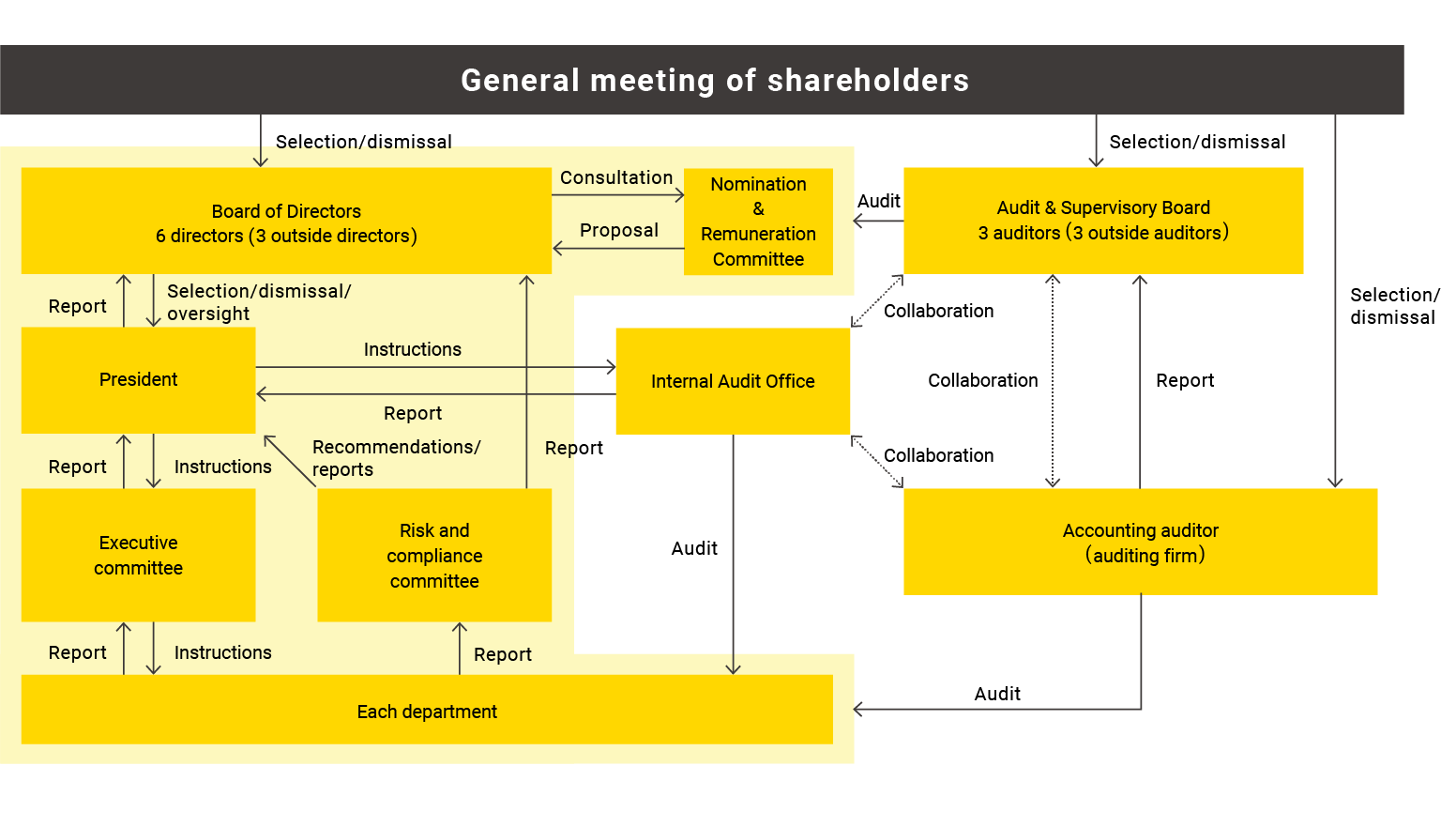
Corporate governance chart

Corporate governance chart

Corporate governance report

The Company submits a corporate governance report to the TSE.

  1. TOP
  2. IR
  3. Corporate governance